
“I laughed. Partly at the joke, partly at how Afghan humor never changed. Wars were raged, the Internet was invented, and a robot had rolled on the surface of Mars, and in Afghanistan we were still telling Mullah Nasruddin jokes.”
The Kite Runner
The book:
My first book review was of one I had previously read, by an author with the heritage of a country I had visited, and visited recently. This was my first time reading The Kite Runner (2003), and sadly, I will probably never visit Afghanistan. While many events have changed the status quo in Khaled Hosseini’s homeland in the 16 years since his first novel was published, not enough has changed in the region for casual tourism.

As an internationally bestselling novel, even casual readers have heard of The Kite Runner and its heart-wrenching story of a boy’s journey throughout and away from Afghanistan. Due to its notoriety, I’m going to be more free with spoilers than before. This was not an easy book to read, but I’m very glad this blog project compelled me to read it, finally.
The author:
From what I’ve read, Khaled Hosseini will spend the rest of his life denying claims that his debut novel is in any way autobiographical. Yes, he did grow up in Kabul—even in the Wazir Akbar Khan neighborhood from the book. His family was able to leave Afghanistan before the Soviet and Taliban regimes decimated it, and he settled in California at 15. Both of his parents immigrated with him and he has two children, all characteristics that differ from the protagonist, Amir.
I promise this blog will not solely concentrate on falsely-autobiographical books. Though, you have to admit, these authors each paint vivid stories in their own way when given creative license to…improvise.
Translation:
No. Khaled Hosseini wrote The Kite Runner in English, but he did not speak the language himself until he was 15. However, I was delightedly frustrated by the many Farsi words sprinkled throughout the book. From family titles (Baba=Father) to greetings (Salaam alaykum=Peace be unto you) the language of Afghanistan was sometimes explained but often left untranslated. In a small way, that solidified the story for me.
As well, I will readily admit that I had not known that Farsi (or Dari) was the national language of Afghanistan. Like many, I assumed it was Arabic. This misunderstanding brings an even greater contrast to the later religious domination of the country.
What I loved:
The adult perspective. From the very beginning, the reader is told that this is a story of remembrance, redemption, and regret. Every childhood moment is framed with adult hindsight and a little history. For too many Americans (myself included), Afghanistan is a country overrun by the Taliban, shackled to strict religious doctrine with a harsh climate. The author—and his narrator—gave the perspective of both a comfortable native and a tourist returning to a changed home.
The brutal honesty. While Hosseini was in the midst of writing his novel, planes struck the Twin Towers on 9/11. Suddenly the world’s attention was fixed on Afghanistan and Islam. He could have chosen to take the easy route and painted his homeland in a glowing light of ancient tradition and misguided morals. Instead, he presented a land of contradictions:
“‘We Afghans are prone to a considerable degree of exaggeration…'”
The Kite Runner
“‘We’re a melancholic people, we Afghans, aren’t we?'”
The Kite Runner
As I mentioned at the start of this review, The Kite Runner is not an easy book to read as rape and murder feature strongly. I believe that is entirely necessary: Afghanistan was not an easy country to live in, especially in Amir’s situation. Privileged he may have been, but his life was based on a lie. Amir’s Pashtun ethnicity forever set him above Hassan’s Hazara ancestry, though they were secretly half-brothers. Would knowing the truth have improved how Amir treated his closest companion? Honestly, I think he would have pitied him, and that would have lead to spite. Amir was not an easy character to like, making his redemption all the more important.
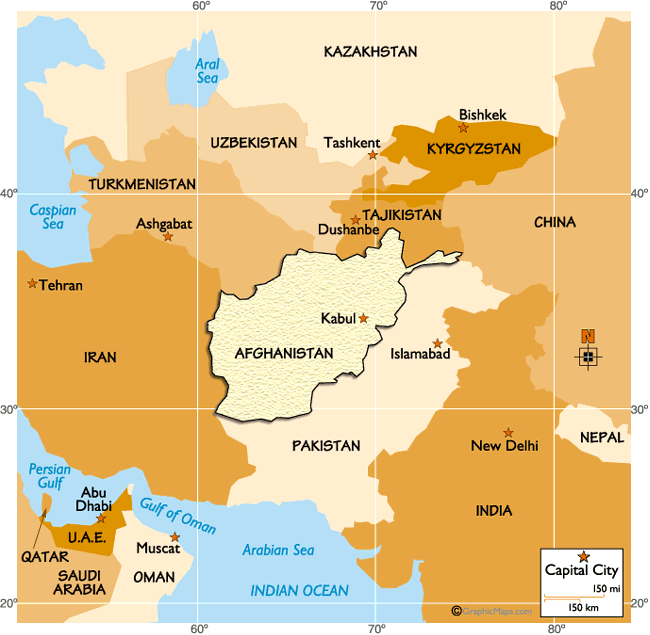
The weight of history. As an American, I was often taught that we are the oldest democracy (debatable), even though we have less than 300 years of history to our name. In contrast, the history of Kabul can be traced to the 7th century, and even modern Afghanistan predates the USA. Hosseini skillfully wove in ethnic, political, religious and gender struggles throughout an inherently simple story of brotherly competition.
What I liked:
The cast of characters. With Amir as the first-person narrator, we are mostly confined to his POV. However, since he originates from a narrative-based culture, he is told many stories throughout his childhood. Stories of his father, his half-brother Hassan, his country and his mother all feed into his eventual career as a writer. I particularly enjoyed the father’s story arc from distant patriarch to fellow immigrant and finally familial confidant. The revelation of his so-called sin and subsequent guilt defined nearly every other character, not just Amir.
The kites. Personally, I’ve never been a big fan of metaphors. But I do think the kites were an allegory for the antagonistic nature of Afghanistan, while also serving as a bridge between the brothers. Hosseini did a nice job of framing the novel with kite running, while also resisting the urge to beat us over the head with the imagery.
The pacing. Amir’s reminiscence begins as a child in 1960s Kabul and we follow him until after his return from Afghanistan in 2002, post-9/11. Hosseini does a good job of focusing on important details to build his theme, while employing backtracking to fill in transitory holes later.
What I could do without:
Hassan’s passive characterization. I understand that this is Amir’s story, but even when Hassan is given a voice in Part III, he is saintly. He blindly supports Amir his entire life, maintains there is good in everyone and never defends himself. Even Amir’s wife Soraya, one of the neglected classes of Afghanistan, is given more dimension in her more brief scenes.
The recommendation:
Consume this book. Though not an in-depth history of Afghanistan or its conflicts, The Kite Runner does a splendid job of bringing humanity and depth to this often forgotten or derided nation. Hopefully, like myself, reading this book will drive you to do more independent research on Afghanistan. Too many people fear what they do not understand, here’s a chance to rise above that fear. Comment your perceptions of or questions about this book below!
Oh, did I mention there’s a movie, too?
 Found in Translation